
The seasonally adjusted India Services Business Activity Index rose from 45.4 in July to 56.7 in August, as the reopening of several establishments and increased consumer footfall boosted sales. The services sector witnessed the first expansion in output in four months and a rebound in business confidence.

The Indian services sector activity fell to a six-month low in September, as new business inflows rose at the slowest rates since March, amid inflationary pressures and competitive conditions, a monthly survey said. The seasonally adjusted S&P Global India Services PMI Business Activity Index fell to 54.3 in September, from 57.2 in August, highlighting the weakest rate of expansion since March. For the fourteenth straight month, the services sector witnessed an expansion in output. In Purchasing Managers' Index (PMI) parlance, a print above 50 means expansion, while a score below 50 denotes contraction.

For the entire 2015-16 fiscal, the factory output grew at 2.4 per cent, down from 2.8 per cent in the previous fiscal.
However, predictions that economic conditions will normalise after the elections underpinned optimism regarding the outlook and supported a stronger upturn in employment.

Manufacturing sector, which constitutes over 75 per cent of the index, grew at 5.5 per cent in November compared to a decline in output by 4.6 per cent earlier

The government on Thursday revised upwards factory output growth rate in April to 2.2 per cent from 2 per cent announced on Wednesday.

Input shortages and low inventories, according to Nomura, will likely lead to production cuts and delayed shipments in the September 2021 quarter.
Manufacturing, which constitutes about 76 per cent of industrial production, grew 2.8 per cent from a year earlier, the statistics office said.
The industrial output data show that manufacturing, which makes up more than 75 per cent of industrial output, grew by 12 per cent in September.

Factory output growth, as measured by the index of industrial production, was at 8.1 per cent in December 2010.
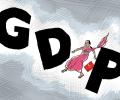
India's economic growth slowed down to 4.4 per cent in the third quarter of 2022-23 mainly due to poor performance of the manufacturing sector. In October-December 2021, the economy grew by 11.2 per cent and by 6.3 per cent in the July-September 2022 quarter, according to data released by the National Statistical Office (NSO) on Tuesday.
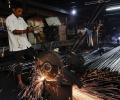
India's industrial production rose to 5.2 per cent in May from 4.5 per cent in April 2023, mainly due to good performance by the manufacturing and mining sectors, according to the official data released on Wednesday. The factory output growth measured in terms of the Index of Industrial Production (IIP) stood at 19.7 per cent in May 2022, mainly due to a lower base effect. "The growth rates over corresponding period of previous year are to be interpreted, considering the unusual circumstances on account of COVID 19 pandemic since March 2020," an official statement explained.

India's services sector activity moderated in December as business activity and sales rose at a softer pace, while price pressures and the possibility of new waves of Covid-19 affected business sentiment, a monthly survey said on Wednesday. The seasonally adjusted India Services Business Activity Index fell from 58.1 in November to a three-month low of 55.5 in December. The rates of expansion moderated but were nevertheless "marked" by historical standards, the survey said.

Output of capital goods -- a proxy for infrastructure investments in the country -- contracted 1 per cent in July
The industrial production growth rate has dipped to 0.1 per cent in July, as against 3.7 per cent in the same month last year.
The manufacturing sector, which constitutes over 75 per cent of the index, grew barely 0.1 per cent, as against 5.7 per cent in April 2011, according to the official data released on Tuesday.

According to Japanese financial services major Nomura, India's manufacturing PMI remained in the expansion zone but suggested some consolidation after the rapid ramp up of activity in December.

India's services sector activity continued to expand in September, supported by favourable underlying demand amid the easing of COVID-19 restrictions, but lost some momentum from August's 18-month high level, a monthly survey said on Tuesday. The seasonally adjusted India Services Business Activity Index fell from 56.7 in August to 55.2 in September, but remained well above its long-run average. "Despite easing from August, the rate of expansion was marked and the second-fastest since February 2020," the survey said.
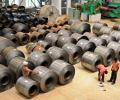
The mining sector grew by 4.3 per cent in June as against a dip of 4.6 per a year ago.

Services companies reported an increase in new work intakes, which they attributed to successful marketing efforts and strengthening demand.

India's manufacturing sector activity contracted for the third straight month in October amid falling levels of production and new orders, as the business climate within the country remained tough, an HSBC survey said on Friday.
India's services sector activity moderated further in January as new business rose at a noticeably slower rate amid the escalation of the pandemic, reintroduction of restrictions and inflationary pressures, a monthly survey said on Thursday. The seasonally adjusted India Services Business Activity Index fell to 51.5 in January, down from 55.5 in December, pointing to the slowest rate of expansion in the current six-month sequence of growth. For the sixth straight month, the services sector witnessed an expansion in output.
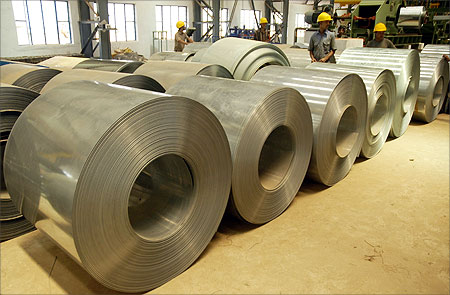
Industrial output fell 3.2 per cent in November.
Led by a recovery in manufacturing output, industrial production grew by 5.9 per cent in November, 2011, after witnessing a contraction in the previous month, a development that may reverse the negative sentiment amid an economic slowdown.

The IHS Markit India Manufacturing PMI rose from 51.2 in November to 52.7 in December. Factories benefited from a rebound in demand, and responded by scaling up production to the greatest extent since May. As per the survey, new work orders witnessed marked improvement, with the pace of expansion picking up to the fastest since July.

The Reserve Bank of India is expected to keep policy unchanged this week as it looks to control inflation.

The HSBC India Manufacturing Purchasing Managers' Index, a measure of factory production, stood at 51.3 in April, unchanged from 51.3 in March, amid moderate expansion of incoming new business orders.

Factory output measured in terms of the Index of Industrial Production had contracted 2 per cent in June last year, as per the data released by the Central Statistical Organisation.
China posted the sharpest increase in output for 15 months, while India saw the steepest expansion since February 2013.
Indian industrial output jumped 5.0 per cent in December as robust domestic demand bolstered the manufacturing sector, official data released on Tuesday showed.

Growth in overall factory output, as measured by the Index of Industrial Production.
'From the time India liberalised in the 1990s, the government has policies are for facilitating the growth of the manufacturing sector.' 'The policies were put in the hope that growth of the manufacturing sector will lead to increased employment,' points out Chidambaran G Iyer, Senior Fellow, Pahle India Foundation.

Announcement of macroeconmic data such as industrial production and inflation, the US Federal Reserve's interest rate decision along with trends in global equities would dictate movement in the stock market this week, analysts said. Besides, foreign fund trading activity would also guide the trends in equities. "All eyes are now on the US Fed policy outcome for cues, which is scheduled on June 14. In the following sessions, the European Central Bank (ECB) and Bank of Japan (BoJ) will also announce their policy decisions.

The HSBC India Manufacturing Purchasing Managers' Index for the manufacturing industry climbed from 49.6 in October to 51.3 in November on the back of a rebound in new orders and output.

India's manufacturing sector activities lost further growth momentum and fell to a seven-month low in March as demand was constrained by the escalation of the COVID-19 pandemic, a monthly survey said on Monday. The seasonally adjusted IHS Markit India Manufacturing Purchasing Managers' Index (PMI) fell from 57.5 in February to a seven-month low of 55.4 in March. However, the latest reading was indicative of a substantial improvement in the health of the sector that outpaced the long-run series average, it said. In PMI parlance, a print above 50 means expansion while a score below 50 denotes contraction.

India's industrial production growth slipped to five-month low of 1.1 per cent in March from 5.8 per cent in February 2023, mainly due to poor performance of power and manufacturing sectors, according to official data released on Friday. The previous lowest level of growth was recorded in October 2022 at a contraction of 4.1 per cent. The factory output growth measured in terms of the Index of Industrial Production (IIP) stood at 2.2 per cent in March 2022.

India's manufacturing sector growth slowed marginally in February, although strong domestic orders were likely to support output expansion in the coming months, an HSBC survey has said.

'India needs many more job creators, both in manufacturing and services, to make it big.' 'For that, the red carpet must be rolled out fully and for all investors without holding back,' suggests Nivedita Mookerji.
India's factory output maintained its robust pace in March, growing by 13.5 per cent despite monetary tightening and a partial roll back of stimulus measures. Driven largely by manufacturing, this was the sixth straight month of double-digit expansion.

Data for the four largest emerging economies showed contrasting activity trends in November. China registered growth for the seventh month running, while India posted the fastest growth since June.
